 Syncswap
 token swaps and multi-pool liquidity
Updated -
Syncswap uses a multi-pool automated market maker to exchange tokens and support liquidity provision on zkSync Era. The protocol connects distinct pool models to shared exchange components, allowing each model to suit different asset behavior. Classic Pools use constant-product pricing, Stable Pools use a hybrid curve for stablecoins, and Aqua Pools add automatic rebalancing for volatile assets and liquid staking tokens. Pool type and protocol version determine how those features apply.
Key takeaway: Aqua Pool rebalancing adjusts its pricing model, while dynamic swap-fee parameters determine a separate part of the trading cost.
Swaps and liquidity within one exchange architecture
Token swaps exchange one asset for another through liquidity pools, while liquidity provision supplies the assets that support trading. An automated market maker, or AMM, calculates trades using a pool's pricing rules. The exchange accommodates different rules through its multi-pool design. Classic, Stable, and Aqua models have distinct functions within the V2 family.
The supporting contracts divide the work. Pool factories create pools of their corresponding types, and Pool Master registers those pools. Pool Master can look up a pool using its two tokens and its type. Fee Manager handles swap-fee settings separately. These relationships explain how a pool belongs to the exchange while retaining its own pricing model and fee configuration.
Classic, Stable, and Aqua pricing
Classic Pools use the constant-product relationship
x*y=k
, the same basic pricing model that Uniswap v2 uses. Here, x and y represent token reserves, and k expresses their product. A trade changes the reserve proportions, which changes the marginal price. Trade size relative to available liquidity therefore affects the exchange rate, alongside the swap fee that the pool charges.
Stable Pools use a hybrid curve comparable to Curve v1's Stableswap model for stablecoin trading. The model suits assets whose values should stay close together. Its pricing behavior differs from a plain constant-product curve. A stablecoin can depart from its intended value, however, and the pool model does not remove that underlying asset risk.
Aqua Pools use a dynamic hybrid curve comparable to Curve v2's twocrypto model. They support trading in volatile assets and liquid staking tokens, often abbreviated as LSTs. Built-in automatic rebalancing adjusts the model as conditions change. This design brings concentrated liquidity to the V2 family.
Concentrated liquidity concerns how the model uses capital. Dynamic fees concern the charge on a swap. Aqua combines these features, but each affects a different part of trading.
What changes between V1, V2, and V3?
V1 introduced Classic and Stable Pools in 2023, V2 added Aqua Pools and security improvements, and V3 has a separate Range Pool deployment architecture.
V2 and V2.1 are iterations of V1, with security changes that affect interactions between contracts. V2 addressed read-only reentrancy, which can affect how another contract interprets pool state during an interaction.
On zkSync Era, the V2 Router supports V1 pools, and the V3 Router supports V1, V2, and V2.1 pools.
The V3 deployment set includes a Range Pool Factory and a Position NFT Manager. These components distinguish its position architecture from the older pool families. The Aqua pricing and fee rules discussed here retain their V2-family scope.
Routers connect pools to exchange operations
A router provides access to exchange operations across pools, while each pool applies its own pricing logic. The V1 Router supports chained swaps and multiple paths within a swap call. Its minimum-output condition rejects an output below the supplied limit.
Price impact and slippage describe different effects. Price impact comes from the trade's effect on pool pricing, including its size relative to liquidity. Slippage describes a difference between expected and execution output. A minimum-output condition constrains what the operation will accept; it does not create liquidity or improve the pricing curve.
Liquidity provision changes the asset exposure
Providing liquidity supplies pool assets in exchange for a claim on that pool, with returns tied to its actual trading and reserve behavior. In a V1 Classic Pool, adding liquidity mints pool tokens. Their quantity reflects the contribution to the pool's liquidity. Removing liquidity burns pool tokens to release the corresponding assets. Trades change the pool's reserve composition, so a liquidity claim can represent different token quantities over time. Relative price changes can leave that position worth less than simply holding the deposited assets separately. Trading fees contribute to pool value, but they do not establish a fixed return or necessarily offset those changes.
Pool selection therefore affects both trading behavior and liquidity exposure. The pricing curve describes how trades use the assets; the liquidity claim describes the provider's participation in the pool. Automatic rebalancing in Aqua is a pricing-model feature, not a promise that deposited assets retain their original value.
How are swap fees determined?
Fee Manager stores default and custom swap fees, and the pool's model and configuration determine whether its fee remains fixed or varies.
Within the Classic, Stable, and Aqua models described for the V2 family, only Aqua supports dynamic fees. Classic and Stable ordinarily use fixed fees. That distinction concerns whether the fee varies dynamically; it does not establish one permanent percentage for every pool. A pool-specific setting can differ from another pool's setting. The Fee Data structure includes
minFee
,
maxFee
, and
gamma
. The first two describe the minimum and maximum fees. Gamma affects fee volatility, with a higher value making fees less volatile. For a fixed fee, the minimum and maximum coincide; gamma is usually zero for Classic and Stable Pools.
Fee Manager itself can change. Pool Master provides the applicable manager address, so integrations should resolve that relationship rather than assume an old address remains valid. Network transaction costs also remain separate from the pool's swap fee. The swap-fee configuration governs the exchange charge, while gas pays for transaction execution.
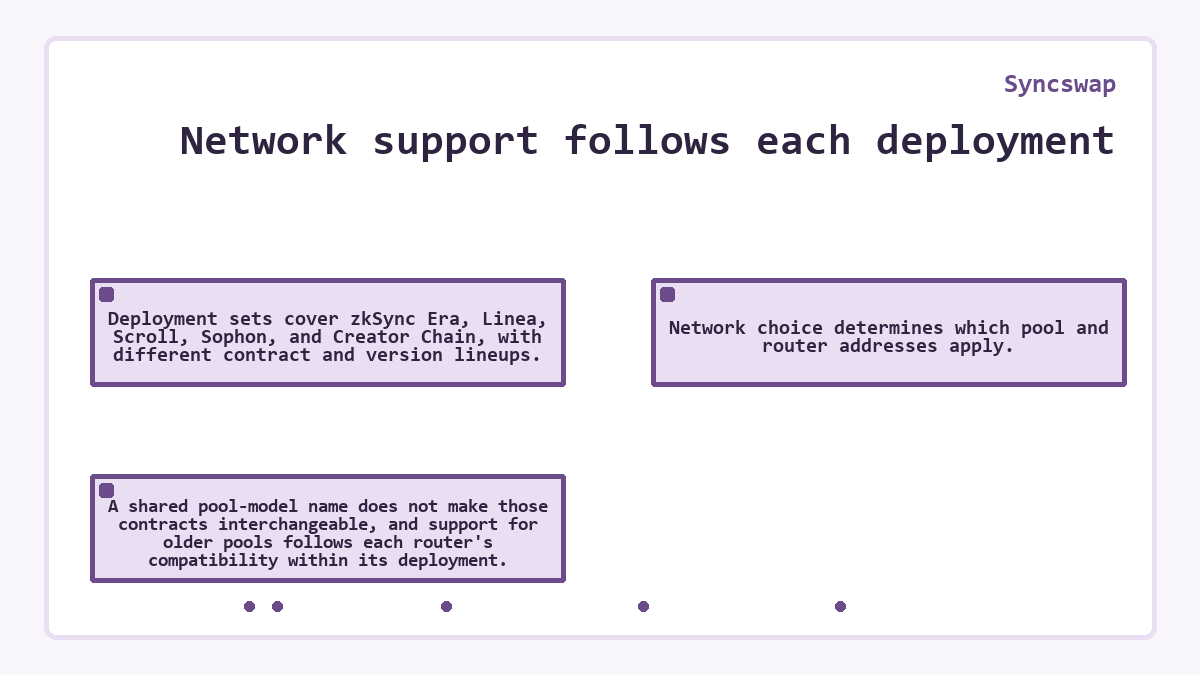
Network support follows each deployment
Deployment sets cover zkSync Era, Linea, Scroll, Sophon, and Creator Chain, with different contract and version lineups. Network choice determines which pool and router addresses apply. A shared pool-model name does not make those contracts interchangeable, and support for older pools follows each router's compatibility within its deployment.
Where do the security limits apply?
Security limits depend on the network architecture, the pool-contract version, and the use that an integration makes of pool state.
V1 pools must not be used as price oracles. An oracle supplies price information to another application, giving pool state a different use from executing a swap. The ability to process trades does not establish suitability for that role. V2's improvements address issues such as read-only reentrancy, so version awareness matters for integrations that depend on pool state. The protocol's use of zero-knowledge rollup technology concerns the underlying network architecture. Pool contracts still govern reserves, pricing, and asset movements. A stablecoin losing its intended value or a volatile asset changing price affects pool holdings regardless of the network's security design.
Matching the operation to the pool and version
The relevant choice starts with whether the task requires exchanging assets, supplying liquidity, or integrating pool data. Each task uses a different part of the protocol. Pool type explains the pricing behavior, and deployment details establish which contracts and version relationships apply.
- For a swap, consider the selected pool's pricing curve, available liquidity, and applicable swap fee.
- For liquidity provision, distinguish the pool claim from holding the underlying assets separately.
- For an Aqua fee calculation, retain the fee bounds and gamma parameter instead of assuming a fixed charge.
- For contract integration, match the router and pool versions to the selected network deployment.
- For price-data integration, exclude V1 pools from the oracle role.
With unequal fee bounds, a higher gamma dampens fee volatility while leaving room for a variable charge in an Aqua Pool.
What to know about Syncswap
Can liquidity be withdrawn into a single token?
The V1 Router includes a single-token liquidity withdrawal function. It burns pool tokens and returns one selected output token through the pool's single-output operation. In a V1 Classic Pool, the output calculation converts the other token's share using pool pricing and the applicable swap fee. The router reverts the withdrawal if the output amount is below the supplied minimum. This contract capability does not establish support in every interface or protocol version.
What happens when a V1 swap passes its deadline?
The V1 Router rejects a swap when the block timestamp exceeds the supplied deadline. Its swap function checks that condition before executing the exchange operation. The deadline is a call parameter, so there is no universal waiting period implied by this behavior.
Why can an unbalanced Classic Pool deposit incur a fee?
The V1 Classic Pool can apply a fee when deposited token quantities do not match the pool's reserve proportions. Its calculation charges the excess contribution using the relevant swap-fee setting. This affects the liquidity calculation, so the minted pool-token amount reflects more than the raw quantities deposited.
Which fee query should an Aqua Pool integration use?
An Aqua integration should use the Fee Data structure containing minFee, maxFee, and gamma. The older function that returns only a uint256 fee is deprecated because one number cannot describe Aqua's dynamic-fee configuration.
Is a Classic Pool the same protocol as Uniswap v2?
A Classic Pool uses the same basic constant-product pricing relationship as Uniswap v2. Syncswap has its own pool factories, Pool Master registry, and fee management. The shared mathematics does not make the protocols or their deployments interchangeable.
Are the V2 and V2.1 contract interfaces compatible?
V2.1 uses the same interfaces as V2. That compatibility preserves contract-call formats, while the applicable deployment still determines the target contracts. Pool addresses remain specific to each version and network.
Does every protocol version use a Vault?
The Vault belongs to the V1 architecture; V2, V2.1, and V3 pools do not use it. On zkSync Era, an integration that routes to V1 pools through a V2 or V3 Router still uses the V1 Vault.